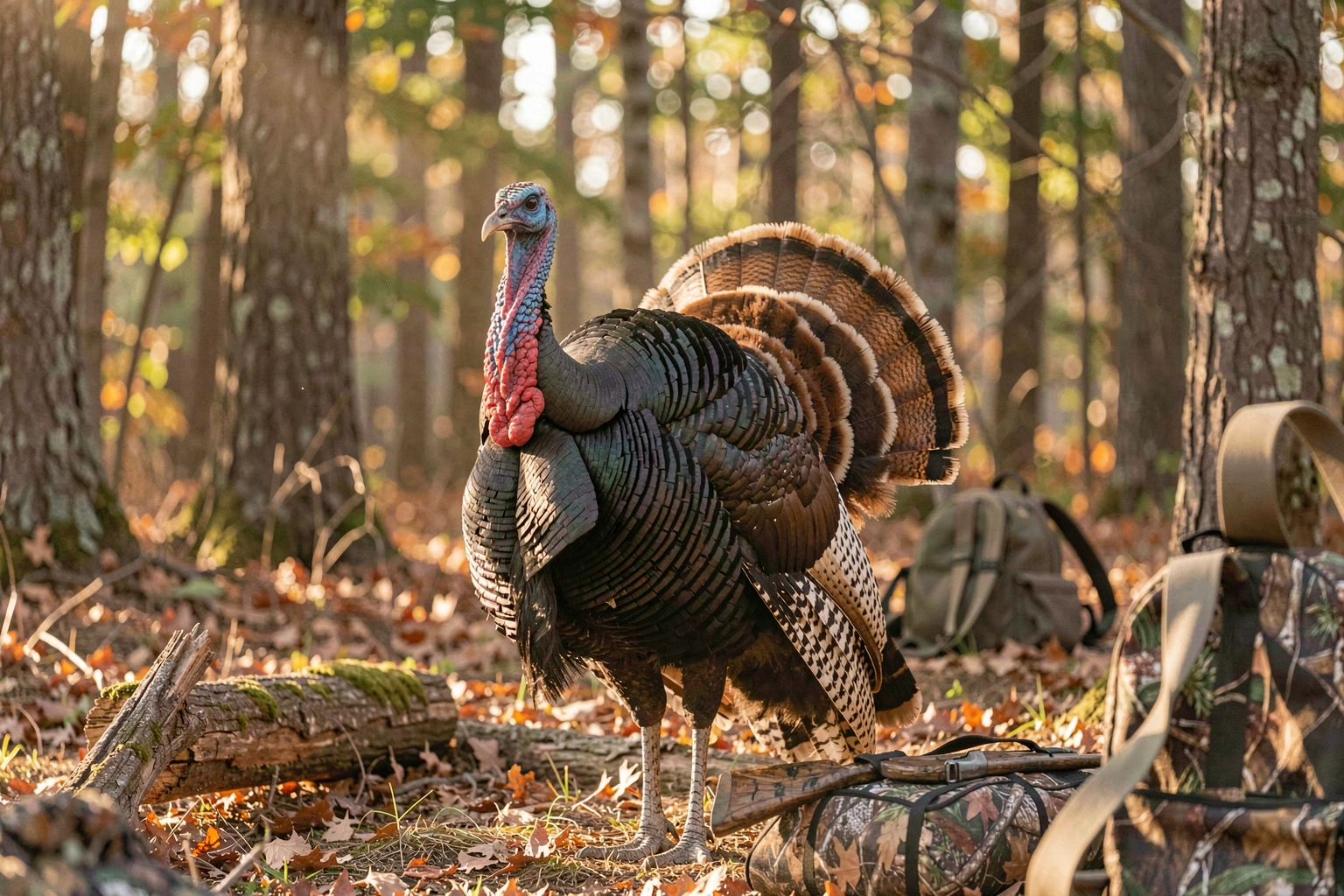
No, T. rex was not a bird, but it was more closely related to birds than to any living reptile alive today. That might sound like a strange thing to say about a 40-foot predator, but the fossil record and modern evolutionary science make a pretty clear case for it.
Was T. rex a Bird? Direct Answer and What Evidence Shows

Maya Bennett
20 Mar 2026
The short answer, before we get into the weeds
If someone asks you whether T. rex was a bird or a reptile, the honest answer is: neither, exactly. It was a non-avian dinosaur, which puts it firmly outside the group we call birds today. But here is the part people find surprising: birds are actually living dinosaurs. They descended from theropod dinosaurs, the same broad group that gave us T. rex. So while T. rex itself was not a bird, birds are essentially its distant cousins who made it through the end-Cretaceous extinction about 66 million years ago when T. rex and its relatives did not.
Think of it this way. You are not a chimpanzee, but you and chimps share a common ancestor. shared ancestry is what makes the question "was t rex a bird" genuinely interesting rather than just a mix-up.
Where T. rex actually fits in the dinosaur family tree
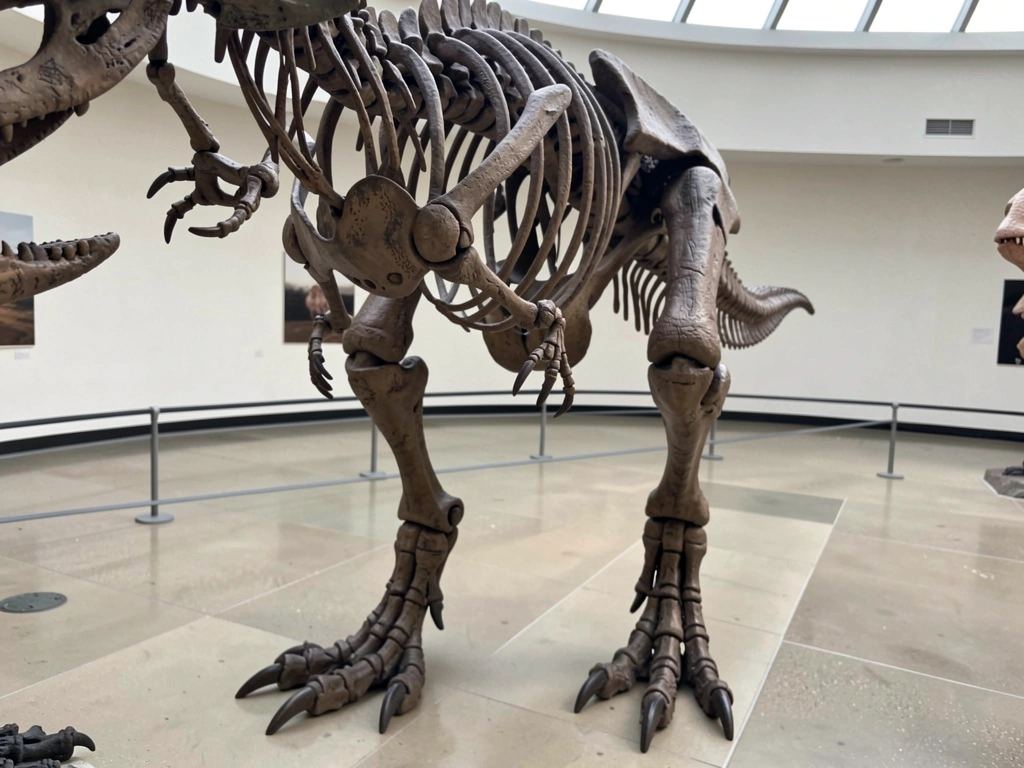
Tyrannosaurus rex belonged to a group called Coelurosauria, which is defined scientifically as the dinosaur lineage more closely related to birds than to other large meat-eaters like Allosaurus. Yes, T. rex is technically in the "closer to birds" bucket, not the "further from birds" bucket. Within Coelurosauria, tyrannosaurs sit as a large, early-branching subgroup, meaning birds are more derived relatives within the same broad clade, not a completely separate branch.
This matters because it tells us T. rex shared a lot of anatomy with early bird-line animals. One of the most striking examples is the furcula, which is the wishbone you snap at Thanksgiving dinner. Paleontologists have confirmed that Tyrannosaurus rex had one. The furcula is a distinctly bird-associated bone, and finding it in T. rex is one of many structural clues that point toward how tightly tyrannosaurs and birds are connected on the family tree.
Did T. rex have feathers?
This is where things get genuinely murky, and the science is worth getting right. The honest position, stated directly by paleontologists at the American Museum of Natural History, is that there is no direct fossil evidence that T. rex had feathers. No feather impressions have been found attached to a T. rex specimen. That is the starting point.
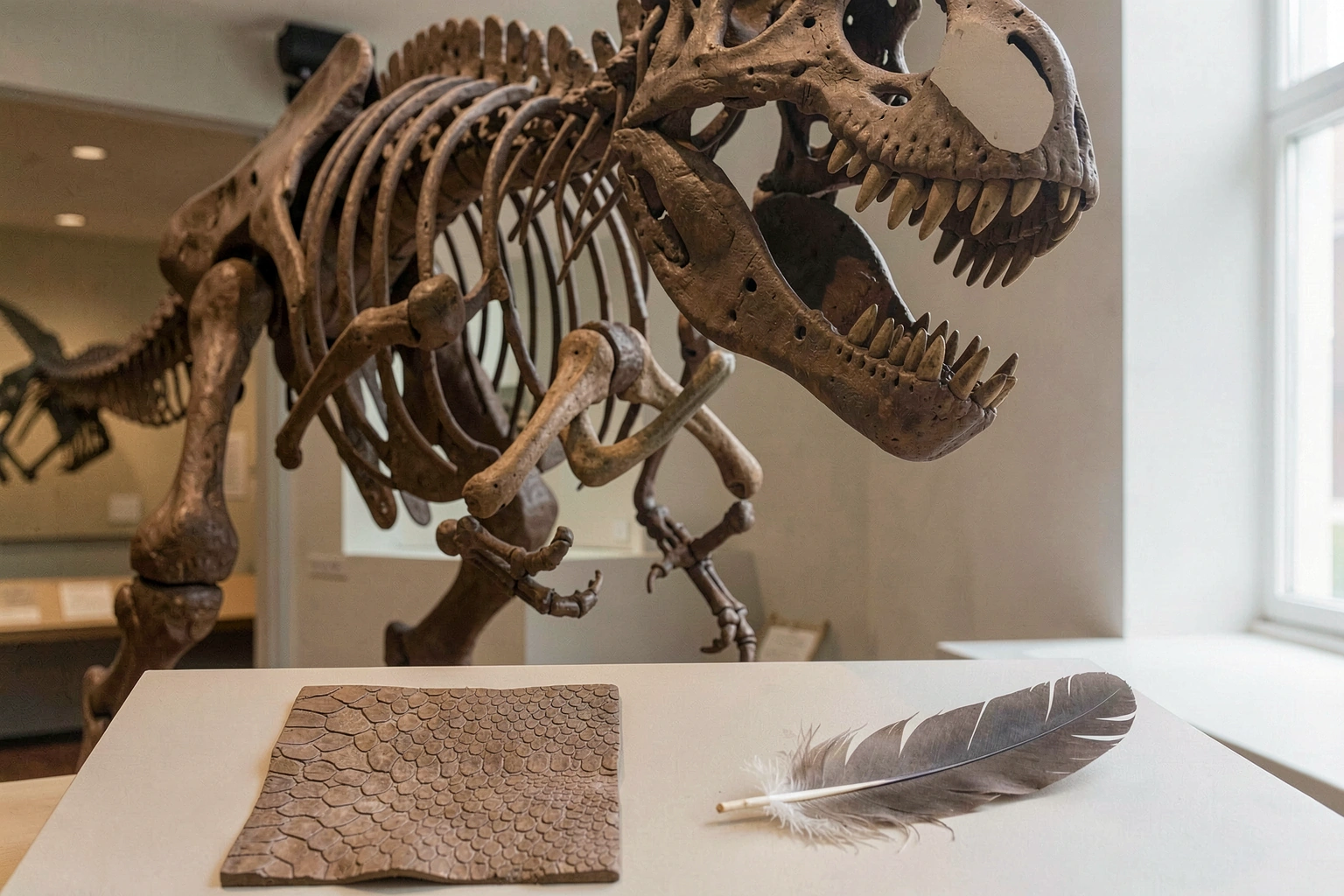
However, no direct evidence is not the same as evidence against. Scientists use a method called phylogenetic bracketing, which basically means: if a dinosaur's close relatives on both sides of the family tree had a trait, the animal in the middle probably had it too, even if you haven't found direct proof yet. Smaller tyrannosaur relatives like Dilong, which lived tens of millions of years before T. rex, did preserve feather impressions. That pushes scientists toward inferring that feathers were at some point part of the tyrannosaur lineage.
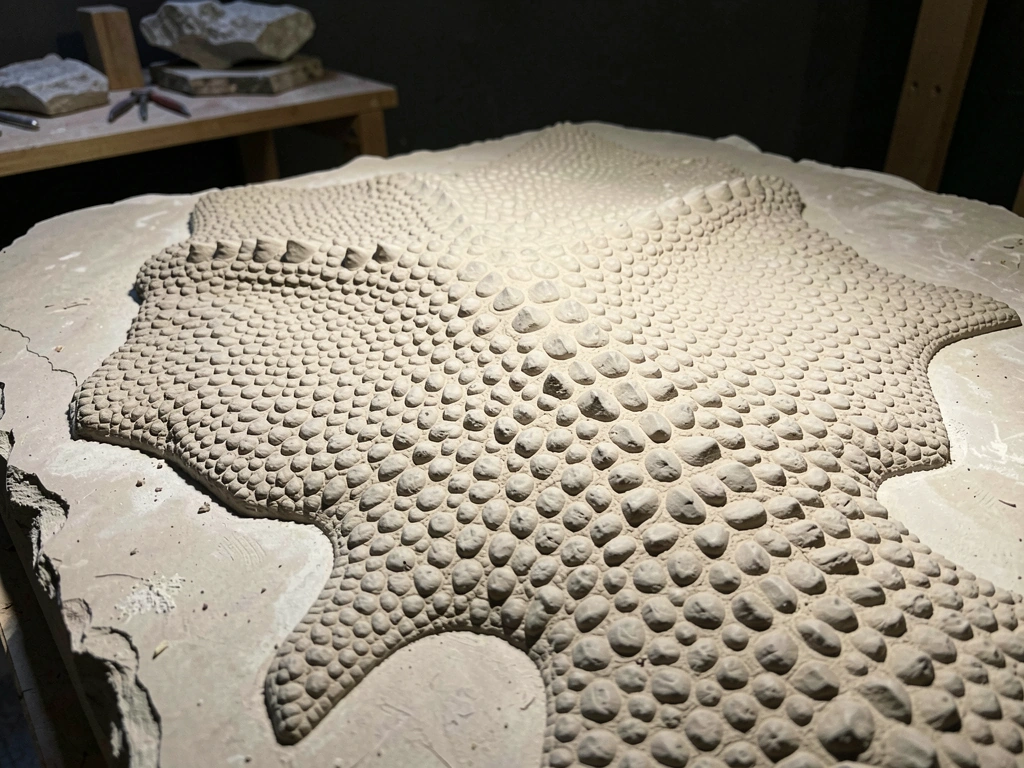
But then there is the skin evidence from T. rex itself. Skin impressions from large tyrannosaurs, including sites covering parts of the neck, hips, and tail, show a pebbly, scaled texture rather than feathery fuzz. The scales are tiny, around 1 to 2 millimeters in diameter for the background texture, with occasional larger feature scales mixed in around 7 millimeters. A 2017 study by Bell and colleagues looked at skin impressions across multiple tyrannosaur species and concluded that large adult tyrannosaurids were likely mostly or entirely scaly, without the broad feathery covering that earlier, smaller relatives seem to have had.
One interpretation is that feathers were secondarily lost as tyrannosaurs grew larger. Big animals have a harder time shedding body heat, so shedding insulating feathers as you get huge actually makes physiological sense. Whatever the full picture, the current evidence points to a mostly scaly T. rex, possibly with some limited feathering in patches, but probably not a fluffy dinosaur the way pop-science imagery sometimes suggests.
What makes a bird a bird, and why T. rex does not quite qualify
Birds, as a technical group, are defined as the avian dinosaurs that evolved from theropod ancestors and survived to the present day. The earliest well-known member of this line is Archaeopteryx, a Late Jurassic creature from about 149 to 150 million years ago that had feathers, wings, and a mix of dinosaur and bird-like features. Archaeopteryx is fascinating precisely because it sits right on the boundary between what we call dinosaurs and what we call birds.
T. rex lived about 68 to 66 million years ago, tens of millions of years after Archaeopteryx. By that point, true birds had already been evolving for a long time. T. rex was not on that lineage. It was a large, likely warm-blooded, bipedal predator with bird-like bones and a wishbone, but it lacked the full suite of features, especially functional wings and the specific skeletal modifications, that would put it in the bird category.
Bird vs. reptile: is t-rex a reptile or bird?
This framing of "is t rex a reptile or bird" is a reasonable one to ask, but it creates a bit of a false choice. Under older classification systems, T. rex would have been called a reptile. Under modern evolutionary classification, all dinosaurs including birds are technically within the reptile family tree, but birds have been so dramatically modified that most scientists treat them as their own distinct group.
| Feature | T. rex | Modern Birds | Modern Reptiles (e.g., Crocodiles) |
|---|---|---|---|
| Closest living relatives | Birds | Each other | Birds and dinosaurs |
| Wishbone (furcula) | Yes | Yes | No |
| Feathers | Likely none on adults (scales preserved) | Yes | No |
| Bipedal posture | Yes | Yes | No (mostly) |
| Hollow bones | Yes | Yes | No |
| Warm-blooded metabolism | Likely yes | Yes | No |
| Survived the K-Pg extinction | No | Yes | Partially |
Looking at that comparison, T. rex shares more structural features with birds than with living reptiles like crocodilians or lizards. The hollow bones, the wishbone, the upright two-legged stance, and the probable warm-blooded metabolism all line up more closely with birds. But T. rex is still not a bird in any rigorous scientific sense. It is an extinct non-avian dinosaur that sits on a branch of the family tree that is closer to birds than almost anything else that ever lived.
Why this question keeps coming up
Part of the reason people keep asking "was the t-rex a bird" is that the science has genuinely shifted over the last few decades. For most of the 20th century, dinosaurs were portrayed as cold-blooded, slow-moving, and reptile-like. Then evidence started piling up: hollow bones, bird-like breathing systems, feathers in small theropods, wishbones in large ones, and behavioral hints from nesting fossils. The picture of dinosaurs changed dramatically, and T. rex changed with it.
Popular media caught up slowly. Some articles ran with headlines suggesting T. rex was basically a giant chicken, which is a fun image but an oversimplification. The more accurate framing is that T. rex and chickens share a common ancestor deep in the theropod family tree, and modern birds carry forward a lot of the biology that tyrannosaurs also had, just in a much smaller, flying package.
What the evidence actually tells us, in plain terms
Here is a clean summary of what we know with reasonable confidence and what remains genuinely uncertain.
- T. rex was a theropod dinosaur in the group Coelurosauria, which is scientifically defined as the lineage closer to birds than to other large meat-eaters.
- T. rex had a wishbone (furcula), a bone associated with birds and confirmed in tyrannosaur specimens.
- No direct feather impressions have ever been found on a T. rex fossil.
- Preserved T. rex skin shows small pebbly scales, not feathery textures.
- Smaller, earlier tyrannosaur relatives like Dilong did have feathers, so feathers existed somewhere in tyrannosaur ancestry.
- Large tyrannosaurs may have lost feather coverage as adults, possibly due to body size and heat management.
- Birds are the only surviving dinosaur lineage and are T. rex's closest living relatives, closer than any living reptile.
- Archaeopteryx, the early bird-line dinosaur from the Late Jurassic, is a separate lineage from tyrannosaurs and does not make T. rex a bird.
So what do you actually call T. rex?
The most accurate label is non-avian theropod dinosaur. "Non-avian" just means it is not in the bird line. "Theropod" puts it in the group of bipedal, mostly meat-eating dinosaurs. That group includes both T. rex and the ancestors of birds, which is why the relationship keeps coming up. Calling it a reptile is not exactly wrong under the broadest definitions, but it misses how closely connected it is to birds compared to any living scaly animal.
If you want a fun way to explain it to someone: next time you eat a chicken wing, you are eating the arm of a dinosaur whose lineage diverged from T. rex's family tree deep in the Jurassic period. T. rex did not turn into a bird. But the same ancient family tree produced both, and that is what makes the connection genuinely worth talking about.
A quick profile if you want the fast take
| Question | Answer |
|---|---|
| Was T. rex a bird? | No, it was a non-avian dinosaur |
| Is T. rex a reptile or bird? | Closer to birds evolutionarily, but technically neither in modern terms |
| Did T. rex have feathers? | No direct evidence; skin impressions show scales on adults |
| Did T. rex have bird-like bones? | Yes, including hollow bones and a wishbone |
| What is T. rex's closest living relative? | Modern birds |
| When did T. rex live? | About 68 to 66 million years ago (Late Cretaceous) |
The bottom line is that "t rex was a bird" is more of a poetic truth than a literal one. It was not a bird. But it was the kind of animal that makes birds make a lot more sense once you understand where they came from.
FAQ
Was T. rex definitely featherless?
Not directly. No one has found a T. rex specimen with preserved feather shafts, feather bases, or clear feather impressions attached to it, so any “T. rex was fuzzy” claim is inference layered on top of indirect clues.
If T. rex was not a bird, what would its skin and covering most likely have looked like?
You can expect mostly scales based on skin impressions from large tyrannosaurids, especially the pebbly texture pattern on adult animals. If feathers existed at all, the best guess is that any feathering was limited to small patches or early growth stages rather than a full birdlike coat.
How can T. rex be “closer to birds” yet still not be a bird?
It depends on how close you are to the bird lineage. T. rex is in a theropod dinosaur branch that leads toward birds, but birds require surviving down the specific avian evolutionary line to the present, which T. rex did not.
Why do some researchers think feathers could have been lost as tyrannosaurs got bigger?
Size is a big part of the debate. Scientists often argue that bigger tyrannosaurs may have shed insulating filaments as they evolved toward a mostly scaly skin covering, because large bodies handle heat differently than small ones.
Does the presence of a wishbone mean T. rex had feathers too?
Not yet in the simple, movie-style sense. A furcula (wishbone) is strong evidence of shared pectoral anatomy with bird-line theropods, but it does not automatically prove feathers, color patterns, or a fully birdlike lifestyle for T. rex.
Could T. rex have had feathers in patches without contradicting the scale evidence?
Maybe, but “feather-related structures” is not the same as “feathers like a modern bird.” Skin impressions can preserve scales and sometimes filament-like evidence is debated, so the safest takeaway is that T. rex did not wear feathers in the straightforward, widespread way birds do today.
Is the answer different if I mean “bird” in a casual way versus a scientific definition?
Yes, but start with what the question actually means. If you’re asking in the everyday sense (birdlike or warm-blooded), T. rex overlaps in some traits. If you’re asking in the technical sense (an avian dinosaur lineage that survived to the present), the correct answer is no.
Why does the timeline matter for whether T. rex was a bird?
There’s a timing trap. Birds are a descendant lineage that appears well before T. rex in the fossil record. T. rex lived long after the earliest well-known feathered bird-line dinosaurs, so it sat near the family tree of birds rather than on the avian line itself.
Why don’t we see the same “covering” evidence for every tyrannosaur fossil?
Different fossils preserve different things. Rare preservation of integument, the angle of impressions, and whether a specimen is from a young or adult individual can all change what you see, which is why some sites look scaly and others preserve more filament-like information in relatives.
What’s the quickest way to sanity-check claims about T. rex having feathers?
A practical way is to separate three questions: (1) Was it in the dinosaur groups that lead toward birds? (2) Did it have bird-defining features? (3) Do we have direct fossil evidence of feathers on T. rex specifically? For (3), the answer right now is no.
Next Article
Is Turkey a Game Bird? Wild vs Domestic Rules and Licenses
Learn if turkey hunting counts as game bird hunting, plus wild vs domestic rules, licenses, and next steps.